OPUNTIA PROJECT

Group Project 

With: Pilar Farres-Michelle Wilson-Fiona Morrison

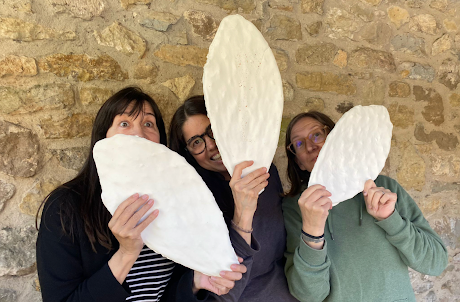
Opuntia magazine by Pilar Farres, Michelle Wilson and Fiona Morrison


Three woman artists from catalonia Pilar Farres, Michelle Wilson and Fiona Morrison


EL VOL- EL VUELO- THE FLIGHT

Solo show 

Gallery: EL QUADERN ROBAT- Barcelona

Galerist: Anna Belsa

Artist Fiona Morrison Once Upon A Feather exhibition

Poetics of Time and Place in the Work of Fiona Morrison


Anna Belsa


Maria Zambrano once said that inhabiting a place implies a recreation of time. This idea permeates Fiona Morrison's creative work. Hers is a body of work that transcends all disciplines, from painting to installation, from photography to video. Since the beginning of her career as an artist, she has always sought the medium that best expresses the idea she wants to convey. The notion of the passage of time, and how this passage imbues itself in the places and the people who inhabit them, is a constant theme in her work, already present at the beginning of her artistic career.


The first works I remember from Fiona Morrison are a set of photographs she exhibited at Galeria Joan Prats-Artgràfic in the summer of 2003, under the title "Malenconia." Those photographs captured scenes, both natural and artificial, outdoors and indoors, all sharing a common denominator: the idea of space had transformed into the idea of "place." What was visible was important, but so was everything that was not seen. Everything that emanated from the idea that those places had been inhabited or experienced. They were delimited places laden with memory, with lived experience. Perhaps that's why she titled this series "Malenconia," for all the weight of memory contained in each image.


Subsequently, she continued to delve into this idea through a series she titled "A Special Place," which consisted of portraying different artists in a location chosen by them. It had to be a place where they felt free or protected, a place where they recharged their batteries, drew inspiration, felt identified; or simply a place where they felt comfortable. This work, which we could consider a work in progress, as Fiona Morrison still continues it intermittently, had a dual interest. On one hand, the qualities of the portrait, which Morrison masters perfectly, and on the other hand, because it introduced this idea of place we mentioned earlier. The location of each of the portraits, the special place chosen by each of the artists, spoke to us about their own works. Perhaps without being fully aware, their places had the essential features of their creative poetics. They were places "inhabited" by their memory, by their thoughts, places that clearly referred to the concretization of their worldview. Fiona Morrison's work had another added interest: in this quest to physically incorporate time into her portraits, she devised small booklets, which she called "Foliscopis" (also known by their English designation, flip books), consisting of numerous consecutive sequences of still photos. By flipping through the pages quickly, the idea of movement was incorporated, as if it were a cinematic image.


Fiona Morrison continued to explore the poetics of place, but from an autobiographical perspective. The resulting photographs, which she generically titled "Llocs/Lugares/Places," had a deliberately evocative power of each of the places from her personal point of view. She photographed landscapes, houses, and cities, seeking to represent significant moments in her life. Those photographs reproduced visible reality, but also conveyed the invisible. Her intention was to crystallize the passage of time, to make memory tangible. This goal led her to make an explicit and conscious use of color. She often used filters to underline the emotional component of the images, to decontextualize the forms and give them a timeless quality. Her photographs taken through a blue filter, for example, endowed the images with the category of memory or even dream.


Once again, she introduced the idea of time, by incorporating a filter that created a temporal distance with visible reality. Two photographs recently exhibited at "el quadern robat" gallery also embrace this idea of incorporated temporality. In one, several images of forests overlap, suggesting a parallel reality, like the one that can occur in a dream. In the other, the illuminated image of leaves, amidst the darkness of the night, suggests the idea of an intense memory engraved in the mind.


The idea of the passage of time is also the protagonist of the video "Two Walks," which was projected at the Venice Biennale in 2014, where Fiona Morrison represented Andorra. The video depicts a walk through a forest by a grandmother with her granddaughter; two women with a consanguineous and spatial proximity, but separated by years. "Two Walks" is a moving vanitas: time passes inexorably for all living beings. Life is fragile and brief, our journey through the world and through life is ephemeral, but if we go beyond the concrete, we realize that it is eternal because everything begins and ends over and over again, and so on to eternity. In this video, Morrison recreates an interesting parallel between the two women and the natural environment through which they walk, identifying the old age of the woman with the thick and yet fragile bark of the trees, and the freshness of childhood in the air that moves the leaves. The path they both follow is nothing other than the path of life.The desire to recreate different artistic disciplines, as we noted at the beginning, has led Fiona Morrison to collaborate with other artists in order to create creative synergies that transcend individuality and achieve a richer purpose of content. 


In this sense, it is worth highlighting the book "L'U," made in harmonious collaboration with the poet Laia Noguera. The result was a perfect combination of poems and photographs that reflected shared moments, complemented sensitivities. Poetry with images, and poetic images, in a happy and energetic flow that managed to infect the reader-spectator with the same attitude of admiration and surprise in front of life, which both had managed to weave with their complicity.


In her most recent exhibition, titled "The Game," Fiona Morrison once again demonstrates her ability to convey her artistic ideals through various disciplines. She suggests we play, and at the same time teaches us how through play, we can understand and learn a whole philosophy of life. The game is freedom, and at the same time learning. Through play, we can learn from mistakes, and project desires and illusions. In this exhibition, we also find articulated the fundamental ideas of all her previous work, which constitute the central axis of her creative poetics: The idea of "place," in the video "Birds" and in the installation "Territory" and the video "American Indian Lands." The idea of the passage of time, in the installations "Time" and "Life." Finally, the idea of all that which is not physically there, but is present potentially, in the installation "Desires," the result of a sculpture workshop with children. Thus, in the idea of play, which entails daring, we find indissolubly linked her creative poetics: for Fiona Morrison, artistic practice is a means to unveil the mystery, to transmit a secret that can help us be more aware and have a richer life. Her artistic (and also vital) work consists of building that intricate and complex fabric that exists between imagination and life.

El Vol-The Flight by artist Fiona Morrison


Reconstruction Game by artist Fiona Morrison


Venice Biennale

Country: Andorra
Curator: Henry Périer
Place: Arsenale
Edition: 55th
Date: june-december 2013


Video Art Work
Title: Two Walks
Duration: 13':13''
Direction and edition: Fiona Morrison
Piano music: Roger Illa Prats 
Musical arrangements: Jordi Casadevall
Two screen edition: Arturo Bastón

Two Walks stils:


Click the image bellow to see the video of the andorran pavillion in youtube:
(by Mira Audiovisual)


EL JOC/ THE GAME

Solo show

Art exhibition at the Valvi Foundation in Girona. All the art installations were interactive, everybody that visited the exhibition could play with them, the younger ones and the older ones. Here I am showing images of the opening.
www.fundaciovalvi.cat

Images of the inauguration 
Photographs by Rafel Bosch
www.rafelbosch.cat

Artist Fiona Morrison exhibition El Joc - The Game

Artist Fiona Morrison exhibition El Joc - The Game

Artist Fiona Morrison exhibition El Joc - The Game

With the Vidal couple owners of Valvi Foundation and director Maguí Noguer 


Artist Fiona Morrison exhibition El Joc - The Game


With the Art commissioner of the Andorran Government


Artist Fiona Morrison exhibition El Joc - The Game


Presentig Montse Miàs the composer of the music in the vídeo Ocells/Birds


Artist Fiona Morrison exhibition El Joc - The Game
Ester Xargay poet and writer, myself and Maguí Noguer director of Valvi Foundation
Presenting the exhibition


Artist Fiona Morrison exhibition El Joc - The Game

Marta and Vega from Magam, the creators of Once Upon A Territory Soundtrack

Artist Fiona Morrison exhibition El Joc - The Game

Artist Fiona Morrison exhibition El Joc - The Game

Artist Fiona Morrison exhibition El Joc - The Game


Montse Miàs, Maguí Noguer, me,Vega Montero, Marta Vila and Ester Xargay 


Seeing if not among voices
Ester Xargay

"I like to confuse myself, to lose myself. I always play. 
The game is good because it leads nowhere, 
it simply consists of just going on."
Pere Noguera

In the photographs, the sea appears solid; if one looks closely, we will see how, from time to time, the seemingly contradictory - or rather, antagonistic and yet identical depending on how they are viewed (and this depending on how they contrast with the second in which they are looked at and depends on who looks at them) - shapes overlap, and the sea becomes a thick glass acting as a magnifying glass. Then, one can glimpse a courtyard, where Pere Noguera observes the rain splashing into a pool of reddish water, indicating that bird flights are reflected in the water, crossing a musical staff that drips. Now we explore these folds of life, behind the marine glass that writing represents, as a reflection of a presumed reality, while the text presents the epiphany of a space, suggested by Fiona Morrison, where forms contradict meanings through papier-mâché, trompe-l'oeil, and other artistic tricks; as poetry does, as Joan Brossa understands it: "a game where, under an apparent reality, another unexpected one appears." Therefore, it is in this poetic game where the joy of losing oneself lies, the gaze lost in the gaze, to find the intangible. And yet, it is not about a space but about an ongoing process, in which Fiona Morrison hunts the shadows of things that with her pieces freely exchange traits, highly acclaimed works for lovers of blue, green, white, stones, teddy bears, and round apricot seeds. She, bit by bit, leads us through landscapes, not at all grandiloquent, where we reflect like upside-down birches, evoking the beginning of a form of the beginning of bristles of a brush trained by a theoretical somersault, and butterflies flutter where everything they land on, among photographs, ceramics, woods, words, or papers.

Carles Hac Mor argues that: "there are moments when all the hours of all times converge before us in a space where all the spaces of the world also fit." Thus, if a squared chalk line on the ground will never imprison a beam of light, Fiona Morrison with a butterfly net will chase, in a jump and stop, what Hac Mor describes as "the spacetime we achieve in an instant that dilates as art does when it merges with our particular tempo and seems to agree with the space that awakens us to wakefulness within the dream.

With a sextant in hand, before dropping anchor, we raise a sea sheet over the day's neck and contemplate how darkness slips away when things arise incognito in the light of the secret that conceives them. And with Fiona Morrison, we rediscover that the star reigns over all effects, but cannot with time, which it dominates with a twist, and on the horizon it is reborn, in another hemisphere. A radiant turn that imposes the night where everything hides in full freedom, and in the moonlight the waves sparkle, brandishing their permanence. Joan Brossa lowers the sails: "behind the words the paper transforms / into the sea. And the letters into colorful fish." We drift, and Felícia Fuster throws us the lifeline, not sparing answers: "what sea step tightens the book of the voice / and this blue wine where I must read the fortunes / orphaned / abandoned / by the low tide." And so we return to port "with the unknown" quoting J.V. Foix: "Don't you always, when you go out to sea and forge ahead, see rocks that appear as giant frames, often strangely and mysteriously symmetrical?" 


Quartered - Esquarterades

Group show

Terracotta Museum of La Bisbal, based on the artwork "Escuarterades" by the artist Maïs Jorba.

In this exhibition, I collaborated on the photographs documenting the creation process of the works by all the artists. I also contributed to the catalog and the posters showcased in the exhibition. Additionally, I created a video detailing the creative process, including my work, PUZZLE, in the collective installation. You can view the video at this link:

En aquesta exposició vaig col-laborar amb la realització de les imatges del procès de creació de les obres de totes les artistes per el cataleg i les carteles exposades a l'exposició, tambè vaig fer un vídeo sobre el procès creatiu i la meva obra TRENCACLOSQUES dins la instal-lació col-lectiva.Podeu veure el vídeo en aquest link:


Artist Fiona Morrrison PUZZLE

Fiona Morrison Museu Terracota La Bisbal


Once Upon a Territory

Video Art Festivals

My video art-documentary film, "Once Upon a Territory," featuring MAGAM's wonderful soundtrack, has been selected to participate in two very special festivals this November-December: The Ethnographic IntimaLente Festival in Caserta, Napoli, and The Human Rights Arts and Film Festival in North Dakota, USA. Starting from January 7th, it will be exhibited at the PLAINS Museum in Fargo and screened alongside the top 8 films of the festival at the Fargo Cinema.


Once Upon a Territory film by artist Fiona Morrison


Fiona Morrison in North Dakota Human Rights Art Festival


TRIBUTES


GROUP SHOWS

Tribute to Vicente Aleixandre 
25 artistas, 25 poemas, 25 años sin Vicente Aleixandre
Curator: Gabriel Serrano
                         
Vida

Un pájaro de papel en el pecho
dice que el tiempo de los besos no ha llegado;
vivir, vivir, el sol cruje invisible,
besos o pájaros, tarde o pronto o nunca.
Para morir basta un ruidillo,
el de otro corazón al callarse,
o ese regazo ajeno que en la tierra
es un navío dorado para los pelos rubios.
Cabeza dolorida, sienes de oro, sol que va a ponerse;
aquí en la sombra sueño con un río,
juncos de verde sangre que ahora nace,
sueño apoyado en ti calor o vida.

Vicente Aleixandre, from his book «La destrucción o el amor» (1933).

Tribute with my work "Vida" (Life)


The group exhibition traveled to:
Sevilla, Ayuntamiento de Sevilla, 2009
Ávila, Navas del Marqués, 2009
Málaga, Centro Cultural Provincial Maria Victoria Atencia, 2010
Ceuta, Fundación Pablo Iglesias, 2011
Sitges, Edifici Miramar, 2011
Madrid, Museo de la Ciudad, 2011
Fez, Instituto Cervantes, 2011

The artists: 
Eduard Arranz-Bravo, Javier Balda, José Manuel Ballester, Enrique Brinkmann, Carmen Calvo, José Manuel Ciria, Florència Coll, Miguel Condé, Juan Genovés, Luis Gordillo, José Hernández, Frank Jensen, Menchu Lamas, Antón Llamazares, Francisco Leiro, José Lucas, Maïs, Santi Moix, Fiona Morrison, Antón Patiño, Manuel Quejido, Javier Rey, Josep Maria Riera i Aragó, Josep Uclés, Joaquín Vaquero Turcios


Tribute to Manuel Vazquez Montalban
Manuel Vazquez Montalban, Pepe Carbalho
Curator: Gabriel Serrano

My work was an inspiration from the book Las Recetas de Carbalho given to me from the curator.

"Arròs de platja amb un toc de núvol", (Beach rice with a touch of cloud)


The group exhibition traveled to:
Oviedo, Sala de Exposiciones del Edificio Histórico, 2018
Elche, Museo de arte contemporaneo MACE, 2018
Roses, Ca l'Anita, 2018
Sitges, Can Rocamora, 2018
Sagunt, Port de Sagunt, 2018
Frankfurt, Instituto Cervantes, 2019
Vilafranca, Claustre de Sant Francesc, 2019
Gandía, Biblioteca Central, 2019
Barcelona, Biblioteca Jaume Fuster, 2017
Girona, Biblioteca Carles Rahola, 2017
Gijón, Centro Municipal Integrado de La Arena, 2016
Sant Feliu de Llobregat, 2016
Cambrils, Sala Ágora, 2022

The artists: 
Jaume Plensa, Francesc Artigau, Eduard Arranz Bravo, Benet Rossell, Juan José Uslé, José Luis Pascual, Josep Maria Riera i Aragó, Menchu Llamas, Waltraud Maczassek, José Manuel Ciria, Eduardo Arroyo, Miquel Navarro, Fiona Morrison, Javier Balmaseda, Abraham Lacalle, Anna Monzó, Joan Pere Viladecans, Maïs, Santi Moiz i Francisco Leiro


Tribute to Luís Cernuda
La realidad y el deseo
Curator: Gabriel Serrano


Tristeza del recuerdo

Por las esquinas vagas de los sueños,

Alta la madrugada, fue conmigo

Tu imagen bien amada, como un día,

En tiempos idos, cuando Dios lo quiso.

.

Agua ha pasado por el río abajo,
Hojas verdes perdidas llevó el viento
Desde que nuestras sombras vieron quedas
Su afán borrarse con el sol transpuesto.
.
Hermosa era aquella llama, breve
Como todo lo hermoso: luz y ocaso.
Vino la noche honda, sus cenizas
Guardaron el desvelo de los astros.
.
Tal jugador febril ante una carta,
Un alma solitaria fue la apuesta
Arriesgada y perdida en nuestro encuentro;
El cuerpo entre los hombres quedó en pena.
.
¿Quién dice que se olvida? No hay olvido.
Mira a través de esta pared de hielo
Ir esa sombra hacia la lejanía
Sin el nimbo radiante del deseo.

Todo tiene su precio. Yo he pagado
El mío por aquella antigua gracia;
Y así despierto, hallando tras mi sueño
Un lecho solo, afuera yerta el alba.

My work was an inspiration from the poem Tristeza del recuerdo, with the title "Luz y Ocaso" (Light and Sunset):


The group exhibition traveled to:
Mieres, Asturias, Centro Cultural Asturias, 2019
Málaga, Centro Cultural Maria Victoria Atenza MVA, 2019
Andorra, Embajada de España, 2022
Cornellà, Castell de Cornellà,2022
Lloret, Biblioteca de Lloret, 2022

The artists:
Luis Gordillo, Maïs, Josep Guinovart, Jorge Castillo, Broto, Cesc, Modest Cuixart, Brinkmann, Javier Balda, Andreu Alfaro, Joseph Bofil, Miguel Ángel Campano, Eva Lootz, Menchu Lamas, Patiño, Fiona Morrison, Javier Balmaseda, Ràfols Casamada, Assumpció Mateu and Susana Pruna


Tribute to Miquel Martí i Pol 
ABECEDARI Solidari
Curator: Gabriel Serrano

With my work "T de Tendresa", (T of Tenderness):


The group exhibition traveled to:
Andorra, Sala d'exposicions del Govern d'Andorra Parc Central, 2022
Sant Feliu de Guíxols, Museu Thyssen Bornemiza, 2022
Vilafranca del Penedès, Sala dels Trinitaris, 2023
Cornellà, Castell de Cornellà, 2023
Castelló, Museu de Belles Arts, 2023
Roses, Ciutadella de Roses, 2023
Calella, Museu del Turisme, 2023

The artists:
Francesc Artigau, Gerard Sala, Maïs, Javier Balmaseda, Eduard Arranz Bravo, José Luis Pascual, Koichi Sugihara, Lluis Cera, Miguel Condé, Josep M. Riera i Aragó, Ricard Llorens, Joan Fontcuberta, Xavier Carbonell, Assumpció Mateu, José M. Guerrero Medina, Carme Solé i Vendrell, Martin Blanco, Santi Moix, Xano Armenter, Fiona Morrison, Robert Llimós, Tatiana Sarasa, Hélène Yousse, Pep Fajardo, Joan Jordà, Regina Saura.

The writers:
Ana Aguilar-Amat, Marai Barbal, David Jou, Cèlia Sánchez-Mústich, Francesc Parcerises, Barbara Scuderi, Meritxell Cucurella Jorbà, Dolors Miquel, Monika Zgustova, Victor Sunyol, Gemma Lienas, Vinyet Panyella, Marta Pérez Sierra, Joan Durán i Ferrer, Laura López, Pau Vadell, Antònia Sabater Bilbeny, Rosa Font, Marius Carol, Valentí Gómez i Oliver, Blanca Llum Vidal, Juani Deulofeu, Jordi Valls, Nuria Martínez Vernís, Victor Amela, Adam Manyé Sardà.